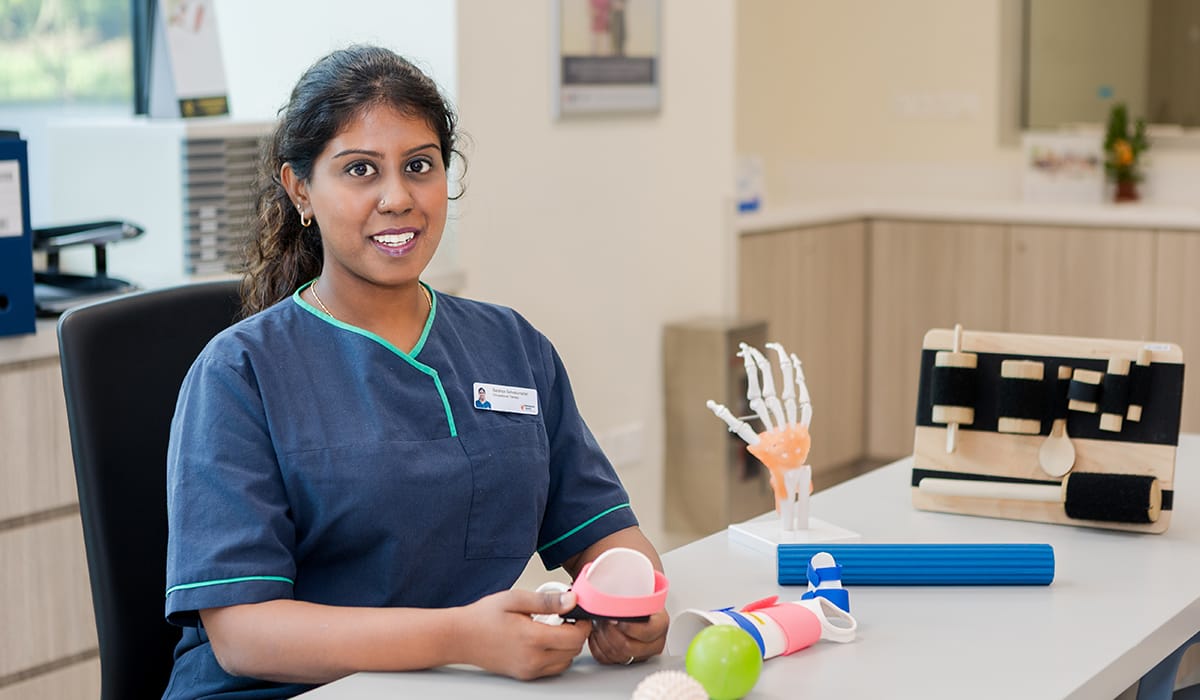
Saranya Selvakumaran is a Senior Occupational Therapist at Woodlands Health, a member of the National Healthcare Group. She is a recipient of the Healthcare Merit Award and holds a Bachelor of Science with Honours in Occupational Therapy from the Singapore Institute of Technology.
From a young age, Saranya Selvakumaran knew she wanted to make a meaningful impact— though the exact path was not immediately clear. Healthcare, however, felt like the right place to start. Growing up with grandparents who required regular care and support, she witnessed firsthand how quality healthcare could transform lives, and was inspired to do the same for others.
Her path became clearer during her polytechnic years, where she discovered occupational therapy while exploring potential paths in healthcare. Encouraged by a facilitator who recognised her interest, she learned about the Healthcare Merit Award—an MOH Holdings (MOHH) scholarship for aspiring healthcare professionals.
“I realised that the Healthcare Merit Award aligned with what I had always wanted, which was to serve the community through public healthcare,” she said.
Taking a leap of faith, Saranya applied for the scholarship to pursue a Bachelor of Science in Occupational Therapy at the Singapore Institute of Technology (SIT). Receiving the scholarship was more than just financial support, it was a powerful affirmation for Saranya.
“Receiving the scholarship was a big form of encouragement for me, motivating me to go above and beyond in my professional growth,” she recounted.
Saranya carried this sense of motivation into her studies. During her programme, which offered hands-on clinical training, she was introduced to the specialised field of hand occupational therapy and saw firsthand how impactful it could be. The complexity and challenges of the work only deepened her interest and drive to learn more.
“It’s incredibly rewarding to see patients regain the ability to return to daily activities which are meaningful to them—whether it’s going back to work, playing a musical instrument, or even something as simple as holding their utensils to eat,” she shared.
From that moment, she knew she had found her calling in this specialised field of healthcare.
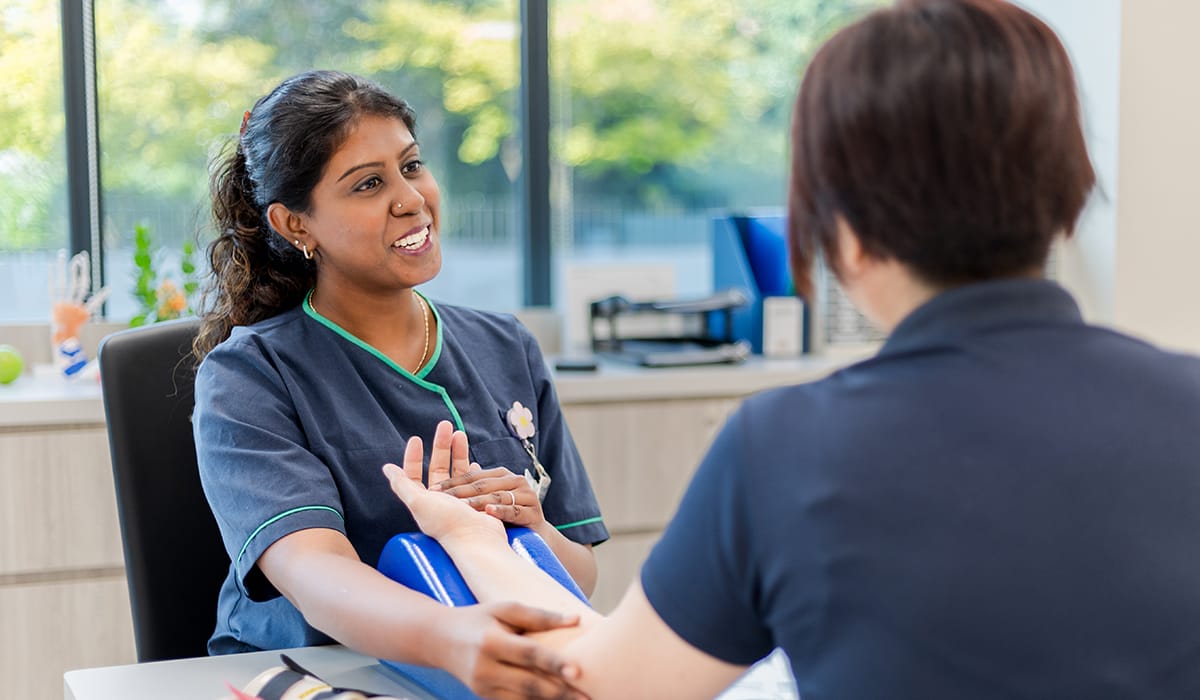
Saranya Selvakumaran
Care That Goes Deeper
Today, as a Senior Occupational Therapist at Woodlands Health’s Outpatient Hands Clinic, Saranya works closely with patients recovering from upper limb conditions such as fractures, tendon injuries, nerve-related issues, and repetitive stress injuries. Her typical workday revolves around scheduled appointments and new referrals from doctors, but every session begins the same way: with listening.
“During the first session with patients, we conduct a thorough assessment of their hand function,” Saranya explained. “We also find out more about their occupations, hobbies, and daily activities that may have been affected by their injury.”
This understanding forms the foundation for collaborative goal-setting.
“Patients are empowered to set their own goals with appropriate timelines, ensuring interventions provided are meaningful and personalised,” she added.
No two patients are alike, even when their injuries appear identical. “Even if they have the same type of injury, each patient is unique,” Saranya emphasised.
This is why she often works closely with hand surgeons and orthopaedic doctors to tailor treatment plans for each individual. These plans include physical interventions—from improving range of motion and strengthening to sensory re-education, scar and edema management, or custom splint fabrication. The ultimate aim is to help patients regain independence in their daily lives.
But for Saranya, therapy isn’t just about restoring movement; it’s also about rebuilding confidence.
“As a hand therapist, my role goes beyond providing physical interventions. It’s about building trust with my patient,” she highlighted. “It’s important for them to know we’re here for them—not just physically, but emotionally too. We have to factor in their psychological stress so we can pace the recovery accordingly.”
She recalls one particularly memorable case involving a foreign construction worker who suffered a crush injury that led to the amputation of his index finger. Although the injury itself seemed straightforward, it was the patient’s first experience with surgery, and the loss left him emotionally distressed. He was anxious about returning to work and faced mounting pressure from his employer, who was unable to grant him extended medical leave. This psychological strain, coupled with a fear of movement, eventually led to stiffness developing in his uninjured joints.
“A straightforward case can become complex when other factors come into play,” Saranya explained. “In this patient’s situation, addressing his stressors was key before we could move forward with physical interventions. Since his employer was involved, it was also important to set realistic goals and timelines that everyone could agree on.”
Beyond treating hand-related injuries at her clinic, Saranya also supports other outpatient clinics, where she assesses patients’ needs and assists with equipment prescriptions such as motorised aid, wheelchairs, commodes, and hospital bed.
Learning Beyond the Therapy Room
While actively engaged in her clinical work, Saranya remains committed to continuous learning. Each month, dedicated time is set aside for clinical development, during which she participates in case discussions with her team and delivers in-service presentations on the latest evidence-based approaches. This culture of shared learning fosters an environment where growth is consistently encouraged and supported.
“NHG has supported me by providing continuous learning opportunities, mentorship with experienced seniors, and interdisciplinary collaborations. I’ve worked on expanding my clinical knowledge by learning on the ground and reading books and journal articles in my free time,” Saranya shared.
This dedication has played a key role in her transition from Occupational Therapist to Senior Occupational Therapist, a role that brings greater leadership responsibilities and involvement in departmental projects.
“With the added responsibilities, time management has become crucial in helping me balance my clinical load with leadership duties,” she reflected.
Looking ahead, Saranya aims to deepen her expertise in hand therapy and continue exploring evidence-based interventions that improve patient outcomes.
“I also hope to strengthen my mentorship and leadership skills,” she added.
For those looking to follow in her footsteps and pursue a career in healthcare, Saranya encourages maintaining a spirit of curiosity and openness to learning. “It’s not a straightforward and easy path. There will be challenging moments, but remember that everything you’re learning is to provide the best care for your patients,” she said.
Saranya’s journey is a reminder that healthcare is not just a profession—it’s a calling grounded in empathy and resilience. For her, every patient’s progress is more than just clinical improvement; it’s a testament to the power of care, connection, and purpose.